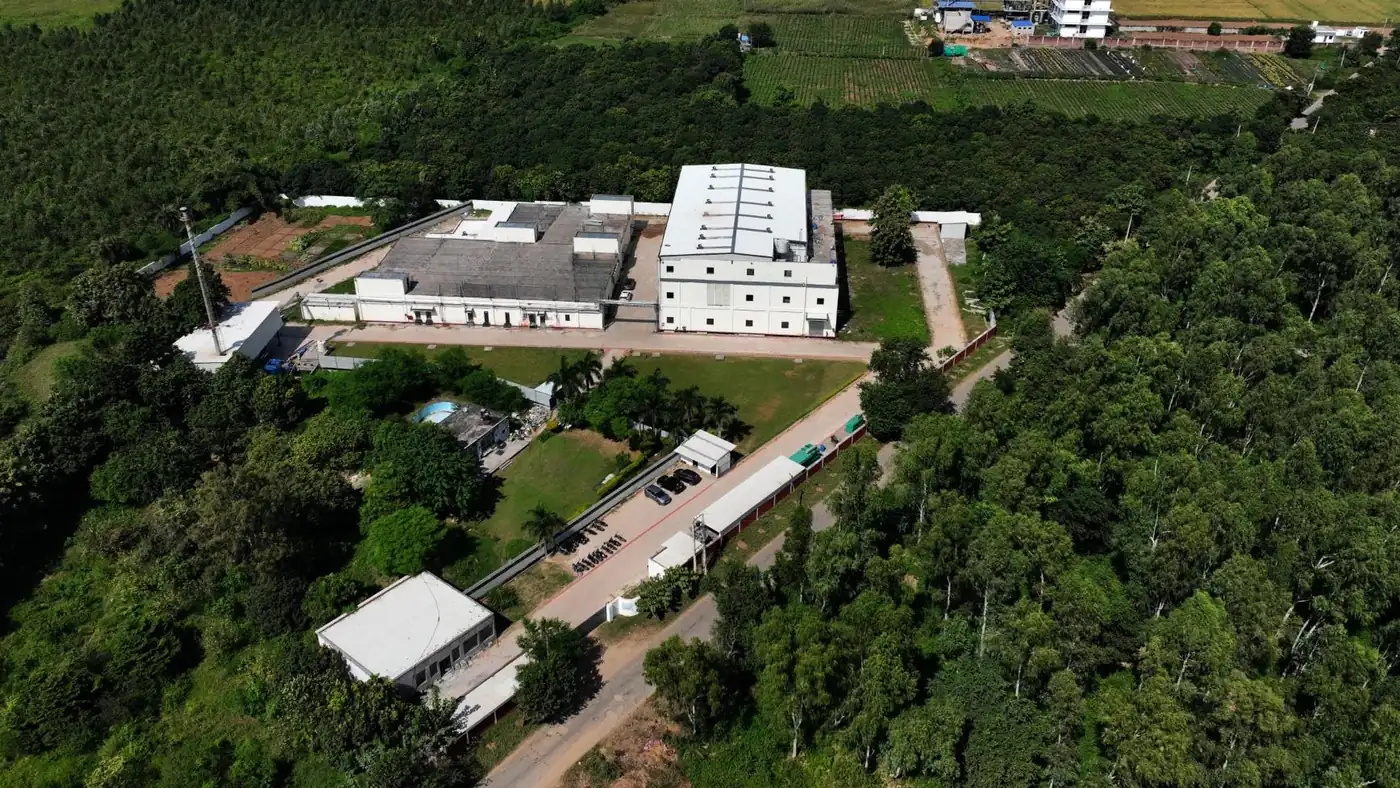
Aerial view of the Vibcare Healthcare plant on its 5-acre site at Dabkori, Panchkula

Pharmaceutical Manufacturing Companies in India: Hubs, Licences and How to Verify a Manufacturer

How the industry is structured, where the plants are, what a licence and a WHO-GMP certificate tell you, and how to check a manufacturer before you place an order.

Home›Third Party Manufacturing›Pharmaceutical manufacturing companies in India

India has about 3,000 drug companies and 10,500 manufacturing units, produces the third largest volume of medicines in the world and supplies a fifth of the world’s generic medicines by volume. The companies behind those figures are of several kinds, work under one licensing system, and cluster in a handful of states. This guide describes that structure, names the hubs with figures from government and industry bodies, explains what a manufacturing licence, a WHO-GMP certificate and a Schedule M certificate each prove, and sets out how to verify any manufacturer from its pack and its papers before an order.

  • Figures from official sources. India Brand Equity Foundation, Invest India, the Government of Gujarat and the Drugs and Cosmetics Rules, each cited where used.
  • Verification, not ranking. The licence forms, certificate types and pack markings that let a buyer check a manufacturer’s claims independently.
  • One worked example. Vibcare Healthcare’s own licence and certificate numbers, shown so the method can be seen on a real plant.

India’s pharmaceutical manufacturing base

Figures from the India Brand Equity Foundation and Invest India

Rank in pharmaceutical production by volume
3rd
Rank by value
13th
Drug companies, approximate
3,000
Manufacturing units, approximate
10,500
Generic brands across 60 therapeutic categories
60,000
Different APIs manufactured
500+
Pharmaceutical exports, FY26
US$ 31 bn
Share of global generic supply by volume
20%

India also has the largest number of US-FDA-compliant plants outside the United States. Sources: India Brand Equity Foundation, Indian pharmaceutical industry (ibef.org); Invest India, Pharmaceuticals (investindia.gov.in); both read on 15 September 2026.

Where the companies are: the manufacturing hubs

States and clusters, with figures where an official source gives one

Gujarat
A third of India’s pharmaceutical market, with more than 1,320 WHO-GMP production facilities and 150 US-FDA-approved units, in four clusters: Ahmedabad (formulations, APIs, biologicals), Vadodara (formulations, biogenerics), Bharuch–Ankleshwar (APIs, formulations, vaccines) and Vapi–Valsad (formulations, APIs, devices). Source: Government of Gujarat, Vibrant Gujarat sector profile. The hub compared with Baddi and Panchkula: third party manufacturing pharma in Gujarat.
Himachal Pradesh
More than 650 operational pharmaceutical units, most of them in the Baddi–Barotiwala–Nalagarh belt of Solan district, built up under the hill-state industrial incentives of the 2000s; formulations for the domestic market and for contract manufacturing dominate. Source: IBEF, Himachal Pradesh state profile. The belt compared with Gujarat and Panchkula, and the 2027 end of its GST support: third party pharma manufacturers in Baddi.
Telangana
Hyderabad and its surroundings hold one of the country’s largest concentrations of API and bulk drug manufacturing; the Hyderabad Pharma City project (US$ 3.81 billion) is listed by Invest India among the sector’s investment locations.
Maharashtra
Mumbai, Thane, Pune and Aurangabad: the head offices of many of the largest companies and formulation plants serving domestic and export markets.
Uttarakhand and Sikkim
Haridwar, Dehradun and Rudrapur in Uttarakhand, and the plants around Gangtok in Sikkim, grew under the same hill-state incentives as Himachal; formulations for the domestic market.
Haryana
The Panchkula–Ambala belt adjoining Chandigarh, and Sonipat, Karnal and Gurugram along the Delhi corridor. Licensing and WHO-GMP certification are issued by the Food and Drugs Administration, Haryana. Vibcare Healthcare’s plant is at Dabkori, Panchkula.
Other states
Goa, Karnataka (Bengaluru), Tamil Nadu (Chennai), Andhra Pradesh (Visakhapatnam, APIs), Madhya Pradesh (Indore, Pithampur) and Punjab (Mohali, Derabassi) each hold clusters of formulation or API plants.

Kinds of pharmaceutical manufacturing companies

By role and by the market they supply

Integrated companies
Own brands, own sales force, own plants. The largest of them also manufacture for others.
Contract and third party manufacturers
Plants that manufacture other companies’ brands under the plant’s own licence, with the brand owner on the marketed-by panel. The largest group by number of plants in Himachal, Haryana, Uttarakhand and Gujarat. See third party manufacturing and how to shortlist one.
CDMOs
Contract manufacturers that also develop the formulation, run the analytical and stability work and transfer the process to their own lines. See how to choose a CDMO in India.
API manufacturers
Chemical synthesis or fermentation of the drug substance sold to formulation plants in India and abroad; concentrated in Telangana, Gujarat and Andhra Pradesh.
Loan-licence operators
Marketing companies that hold a manufacturing licence in their own name for space at another company’s plant; the pack names them as manufacturer.
Market served
Domestic only; semi-regulated export markets in Africa, Asia and Latin America, supplied on the importer’s registration with the manufacturer’s documents; regulated markets, which require the plant to hold the importing regulator’s own approval.

How to verify a manufacturer

Six documents and markings, what each proves and who issues it

1. Manufacturing licence
Ask for: the licence to manufacture for sale, Form 25 and, where the products need it, Form 28, from the state licensing authority.It names the premises, the sections (tablets, capsules, oral liquids, external preparations, and so on) and the products permitted. Check that the section for your dosage form is on it, that your product is listed or applied for, and that the validity date is ahead of your supply period.
2. The licence number on the pack
Read: “Mfg. Lic. No.” on any pack the plant has made.The Drugs Rules require the manufacturer’s name, address and licence number on the label. The number on the pack must match the licence you were shown; a mismatch means the product was made elsewhere or under a loan licence.
3. WHO-GMP certificate
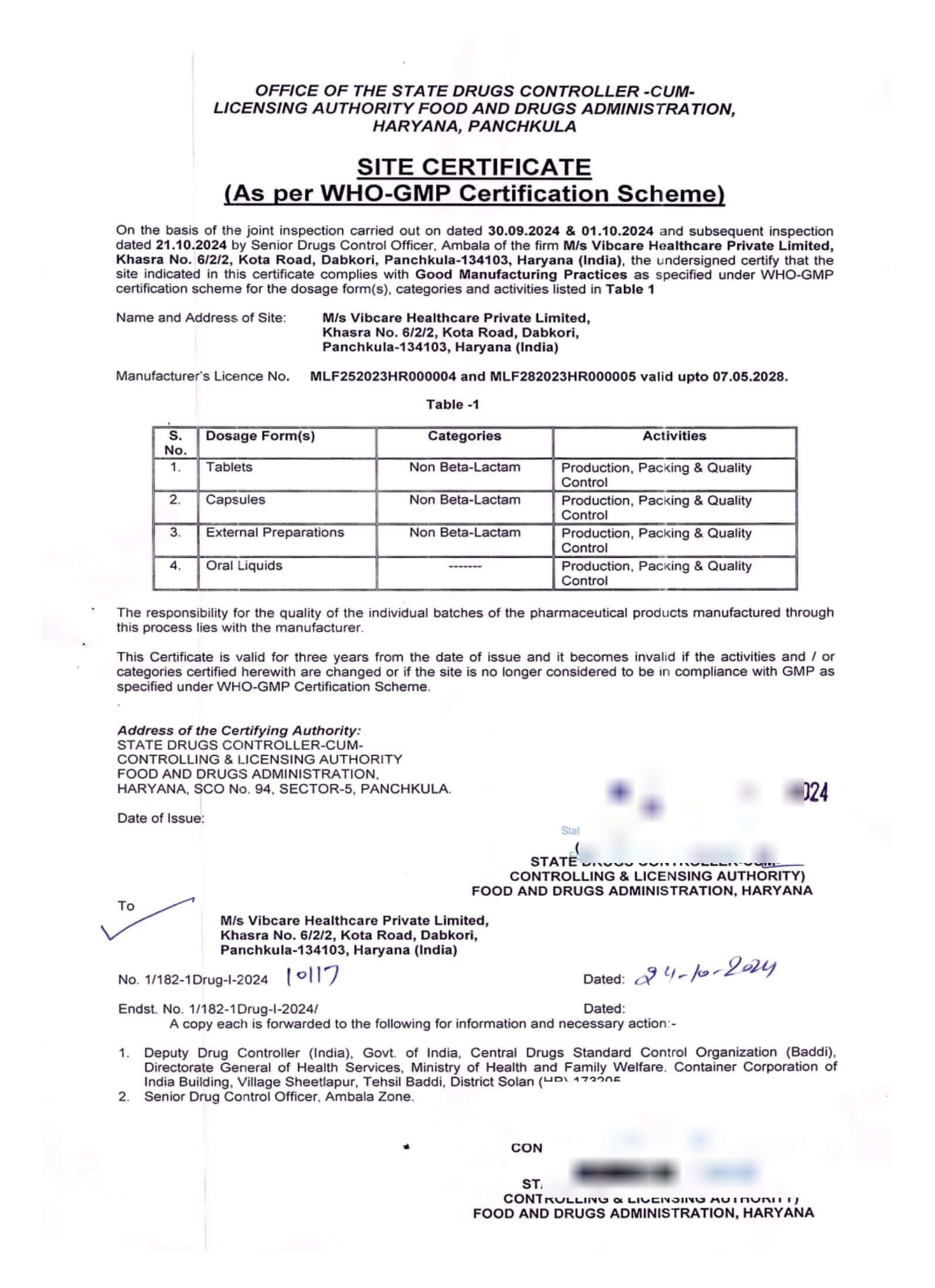
Ask for: the WHO-GMP site certificate, and note the issuing authority, the date and the sections named.It is issued by the state licensing authority after a joint inspection under the WHO Good Manufacturing Practice scheme, for named sections, and it expires. Match the sections to your dosage form; a certificate for tablets says nothing about a liquid section.
4. GMP under Revised Schedule M
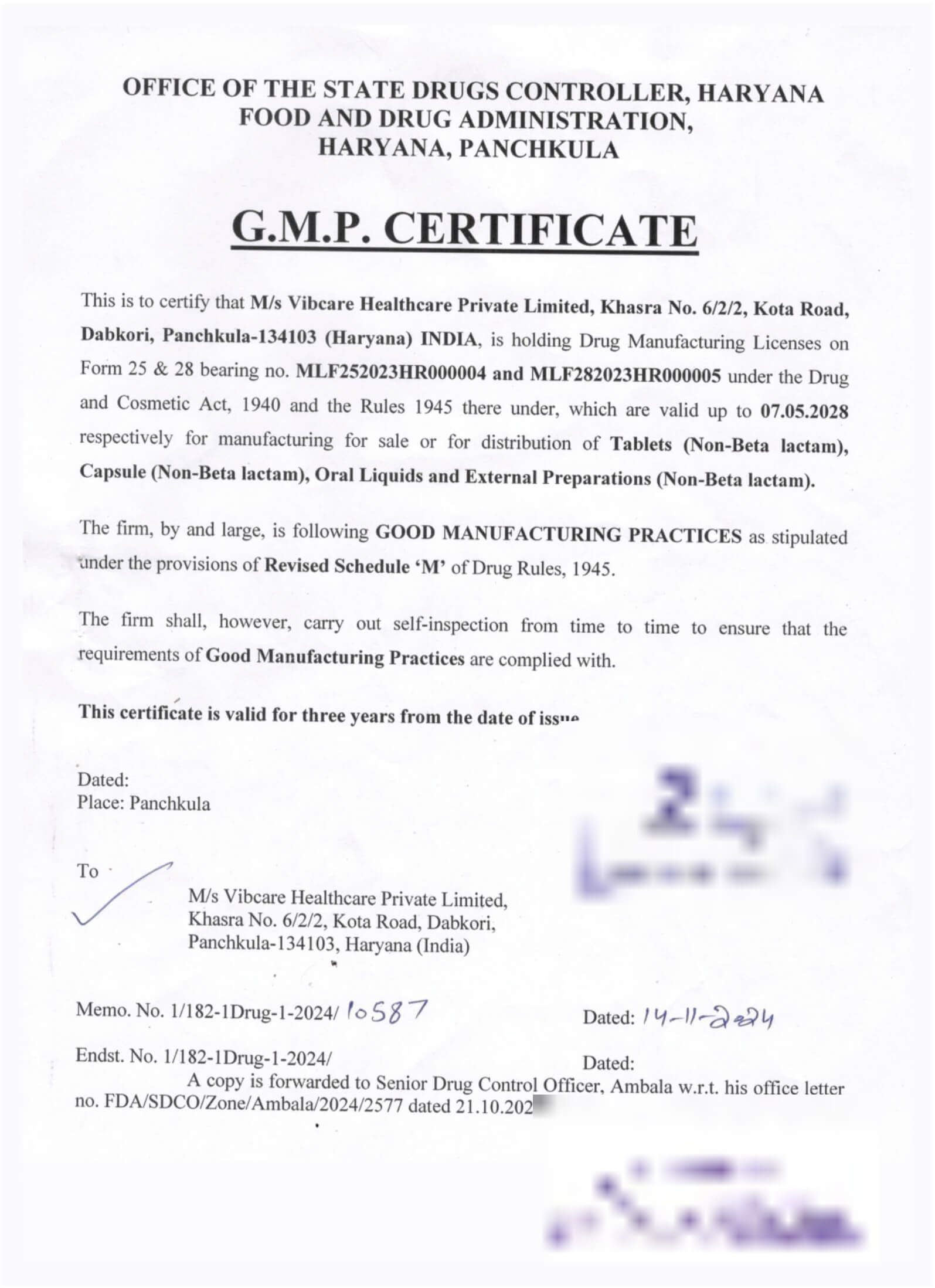
Ask for: the GMP certificate under Schedule M of the Drugs Rules.Schedule M is India’s own GMP code, revised by notification in December 2023 and now applicable to all manufacturers. It is separate from WHO-GMP certification and a plant may hold one, both or neither.
5. GLP certificate
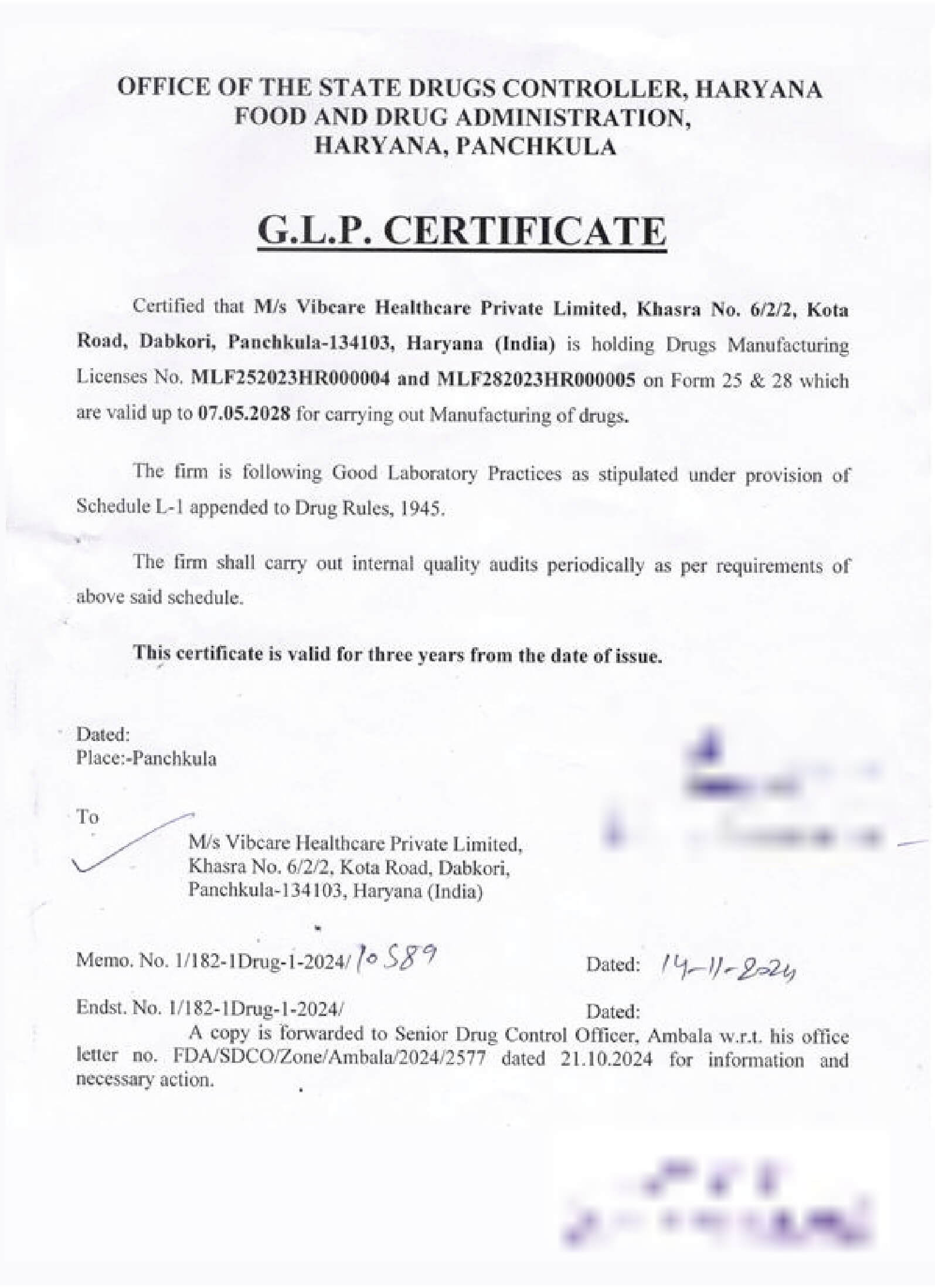
Ask for: the Good Laboratory Practice certificate for the quality control laboratory.It shows that batches are tested and released from a certified laboratory at the plant, rather than at an outside laboratory.
6. For export, a COPP
Ask for: a Certificate of a Pharmaceutical Product in the WHO format for the product you intend to import.Issued by the licensing authority for a specific product from a specific plant; the document an importing regulator asks for with the dossier.

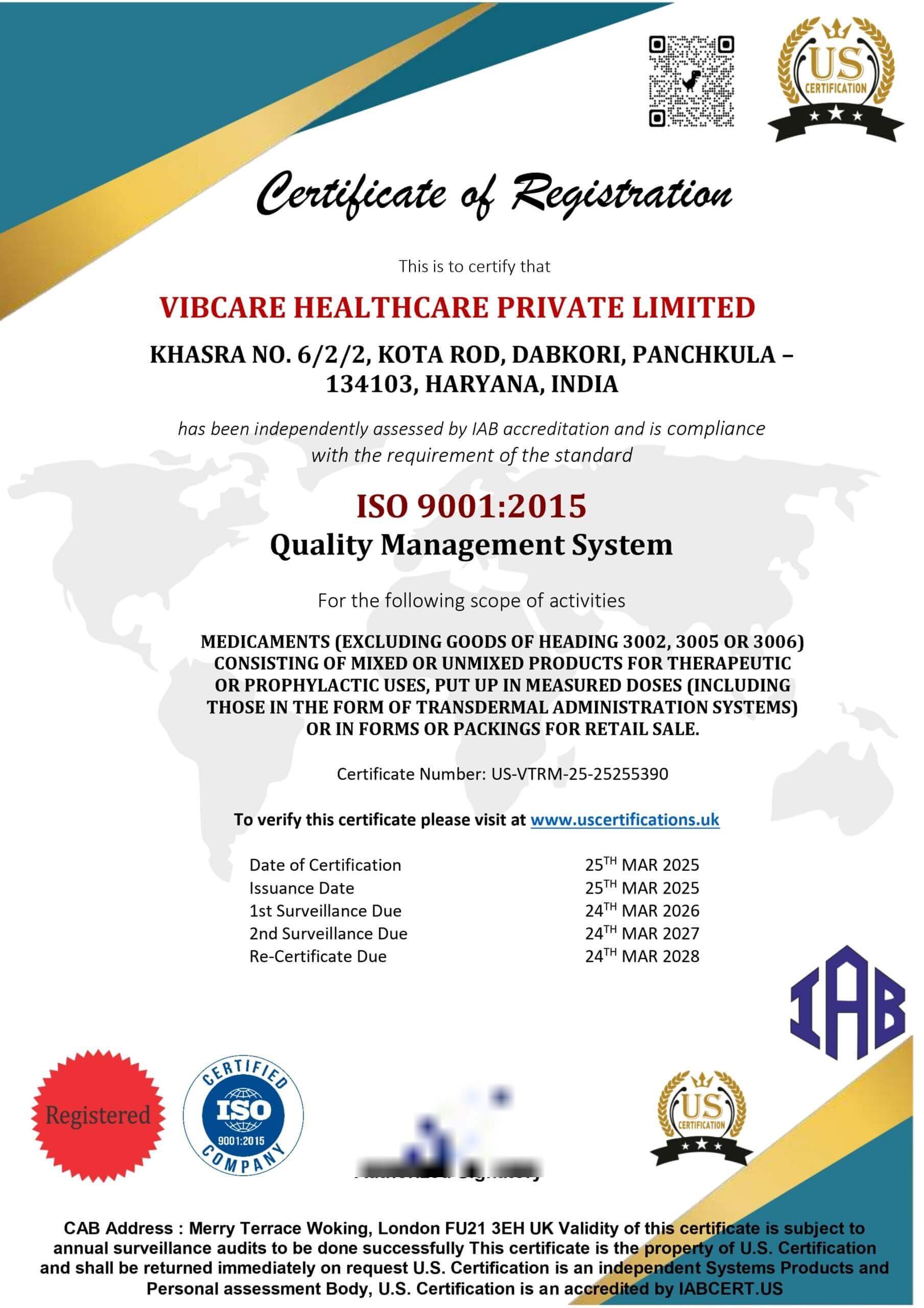
Two things that are often offered in place of the above and do not replace it: an ISO 9001 certificate, which covers the management system and not the medicine, and a description of the plant as “designed to” or “compliant with” a foreign standard, which is a design statement and not a certificate. Ask for the certificate itself, with its number, issuer and date, and then visit the plant.

Send your product list for a written proposal

What a verified manufacturer looks like

Vibcare Healthcare’s plant at Dabkori, Panchkula, as a worked example of the six checks

Blister packing room at the Vibcare Healthcare plant, Panchkula
Analyst at the HPLC in the quality control laboratory, Vibcare Healthcare
Operators at the ACG AF90T capsule filling machine, Vibcare Healthcare plant
Manufacturing licences
MLF252023HR000004 (Form 25) and MLF282023HR000005 (Form 28), issued by the Food and Drugs Administration, Haryana, for tablets, capsules, oral liquids and external preparations at Khasra 6/2/2, Kot Road, Village Dabkori, Panchkula; valid to 7 May 2028. Printed on every pack made at the plant.
WHO-GMP site certificate
No. 1/182-1Drug-I-2024/10117, FDA Haryana, 24 October 2024, naming the four sections for production, packing and quality control.
GMP, Revised Schedule M
Memo No. 1/182-1Drug-1-2024, 14 November 2024.
GLP
No. 1/182-1Drug-I-2024/10589, for the quality control laboratories in the plant’s second block.
ISO 9001:2015
US-VTRM-25-25255390, 25 March 2025, for the management system.
Certification held
WHO-GMP and the Indian licences above; infrastructure designed to EU PIC/S and UK MHRA expectations.

How to shortlist for your purpose

Four kinds of buyer, and the page on this site for each

Your own brands

A marketing company that needs products made under its brand names at a plant it can audit.

Third party manufacturing

A generic range

Many brands, many SKUs, a monthly schedule and a vendor audit before the first order.

Generic medicine manufacturing

A tender or institution

Pharmacopoeial products with the manufacturer’s document set and authorisation for the bidder.

Institutional supply

An export market

The manufacturer’s part of the registration file and the plant open to the regulator’s inspection.

Exports

Questions buyers ask about pharmaceutical manufacturing companies in India

Answered from the plant

How many pharmaceutical manufacturing companies are there in India?

About 3,000 drug companies operating roughly 10,500 manufacturing units, according to the India Brand Equity Foundation and Invest India. The units are licensed by state licensing authorities, so there is no single public list of all of them.

Which states have the most pharmaceutical plants?

Gujarat, with a third of the Indian market and more than 1,320 WHO-GMP facilities by the state government’s count; Himachal Pradesh, with more than 650 units; Maharashtra; Telangana for APIs; and the hill-state and Delhi-corridor clusters in Uttarakhand, Sikkim, Haryana and Punjab.

How do I check a manufacturer’s licence?

Ask for the licence to manufacture for sale (Form 25 and, where needed, Form 28) issued by the state licensing authority, check the sections and products on it, and match its number to the “Mfg. Lic. No.” printed on a pack from the plant. The state authority that issued it can confirm it.

What is the difference between WHO-GMP and Schedule M?

Schedule M is the GMP code in India’s own Drugs Rules, revised in December 2023 and applicable to all manufacturers. WHO-GMP certification is issued by the state licensing authority after inspection under the WHO scheme, for named sections, and is what most institutional buyers and semi-regulated export markets ask for. A plant can hold both.

Is ISO 9001 a pharmaceutical certification?

No. ISO 9001 certifies a quality management system and is issued by a private certification body. The certificates that cover the medicine itself are the manufacturing licence, WHO-GMP, Schedule M GMP and GLP, all issued by the drug licensing authority.

Can any Indian manufacturer export?

Any licensed manufacturer can export to a market whose regulator accepts its documents; the importer registers the product on the manufacturer’s dossier, WHO-GMP certificate and COPP. Regulated markets require the plant to hold that regulator’s own approval, which most Indian plants do not.

What does a WHO-GMP certificate not tell you?

Whether the plant has free capacity, whether it develops products, what it charges, and how it answers a query on a batch. Those come from the proposal and the visit, which is why a licence check is the start of a shortlist and not the end.

Can I visit a plant before ordering?

A manufacturer that expects your order should expect your audit. Vibcare Healthcare’s plant at Dabkori, Panchkula is open to buyers’ quality teams by appointment, about 45 minutes from Chandigarh airport.

How this guide was compiled

Sources and date

Written by Siddharth Singhal, Director, Vibcare Healthcare Private Limited. Industry figures are from the India Brand Equity Foundation and Invest India; Gujarat figures from the Government of Gujarat’s Vibrant Gujarat pharmaceutical sector profile; Himachal Pradesh from IBEF’s state profile; licence and certificate descriptions from the Drugs and Cosmetics Act 1940 and Rules 1945 as amended. Plant facts are Vibcare Healthcare’s own licences and certificates, shown with signatures blurred. No other company is named or ranked. Published 15 September 2026.

Send your requirement today

Products, pack sizes, annual quantity and the market. You will get feasibility, rate, batch size and lead time in writing.

info.vh@vibcare.co.in  ·  +91 85660 76607  ·  Khasra 6/2/2, Kot Road, Village Dabkori, Panchkula, Haryana 134103  ·  Download brochure